Megali Evdomada Μεγάλη Εβδομάδα
Food, fasting & the rhythm of Holy Week

This year my kitchen is in the middle of a renovation, hopefully just four more weeks to go, so Easter will look a little different for me.
I’ll be baking at my daughter’s house this year, which honestly, when I stop and think about it, is a rather lovely thing. The tsoureki will still get made. The eggs will still be dyed. The mageritsa will still be waiting when we come home from church at midnight. The kitchen may be borrowed, but the traditions are entirely our own.
Megali Evdomada, Holy Week in the Greek Orthodox tradition, begins this Sunday and carries us all the way to the midnight chant of Christos Anesti. It is arguably the most significant week in the Orthodox calendar, more so even than Christmas, and the table is where much of it is lived.
This week I want to walk you through each day, not just the liturgical rhythm, but the food that belongs to it. Because in Greek tradition, these two things have never really been separate.
And a little something to look forward to, I’ll be sharing some of my favourite Holy Week recipes with you very shortly. Keep an eye on your inbox.
✶
Day by day through the Great Week
The fasting of Holy Week is among the strictest of the Orthodox year. No meat, no dairy, no oil on certain days, no wine. And yet the cooking is extraordinary.
Monday
Megali Deftera — Great Monday
The week opens with solemnity that the kitchen reflects. Meals are simple, legumes, greens dressed with lemon, olives, bread.
Tuesday
Megali Triti — Great Tuesday
A good day to prepare ahead — soaking chickpeas, making taramosalata, checking the pantry. Be prepared, have your lamp full.
Wednesday
Megali Tetarti — Great Wednesday
One of the stricter fasting days — no oil in the cooking. Everything boiled or raw.
Thursday
Megali Pempti — Great Thursday
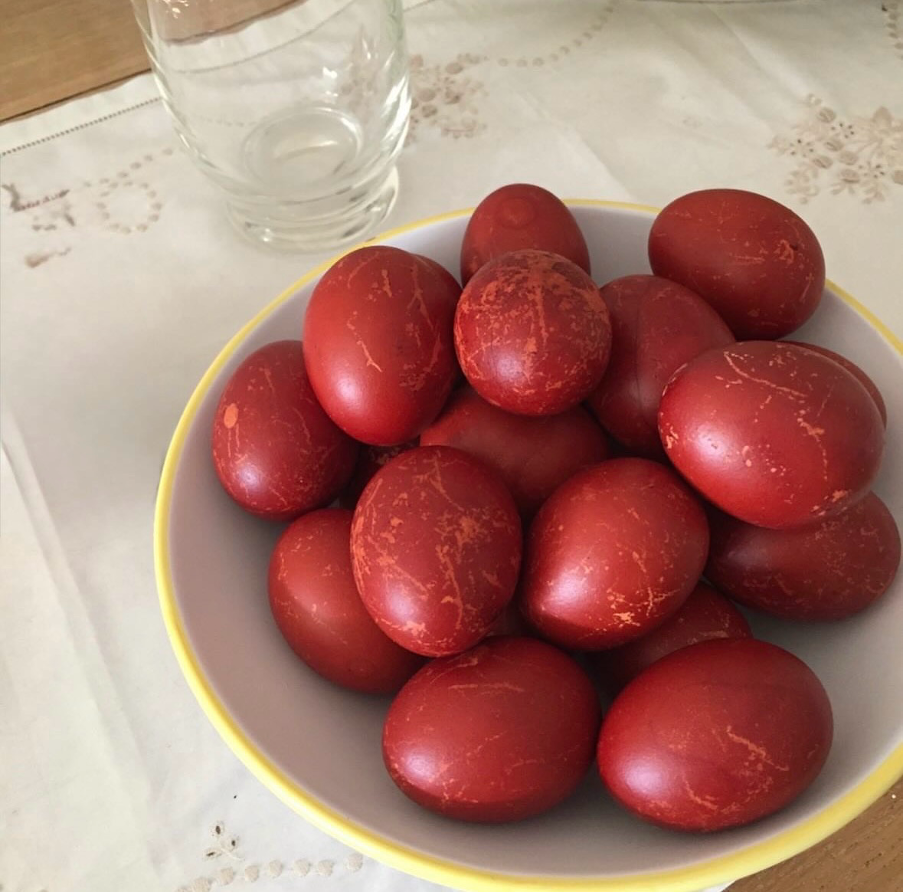
The day the whole house fills with scent. Great Thursday is when we bake tsoureki and dye the Easter eggs deep red. I especially love using natural dyes from brown onion skins — they give a lovely subtle dappled effect. Go to the greengrocer and ask for a bag; they are always happy to help. Add about 3 tablespoons of white vinegar to every 2 litres of water. Once dry, polish the eggs with a little olive oil on a cloth — they come up beautifully.
In the oven
Tsoureki (recipe below), kokkina avga dyed in onion-skin broth, koulourakia
Friday
Megali Paraskevi — Great Friday
The holiest and most austere day. The Epitaphios is carried through the streets by candlelight. Strict observers eat nothing until after the evening service — then only the most modest meal.
Saturday
Megalo Savvato — Great Saturday
Anticipation builds all day. At midnight, candles are lit church to church, the flame passed person to person, and the night erupts: Christos Anesti! Coming home, the fast is broken with mageritsa — a humble soup for such a grand moment, and yet it is perfect.
The midnight meal
Magiritsa (recipe below), tsoureki, red eggs
Sunday
Pascha — Easter Sunday
Everything breaks open. The lamb on the spit, the salads, the wine, the family. There are eggs cracked against each other, someone always wins, and nobody eats less than they meant to.
✶
“The smell of tsoureki baking on Great Thursday is my earliest food memory. That sweet warmth — mahlepi, vanilla, something yeasty and golden — it doesn’t just mean Easter. It means that everything difficult is almost over.”
✶
Coming soon
Holy Week recipes - arriving in your inbox shortly.
✶
